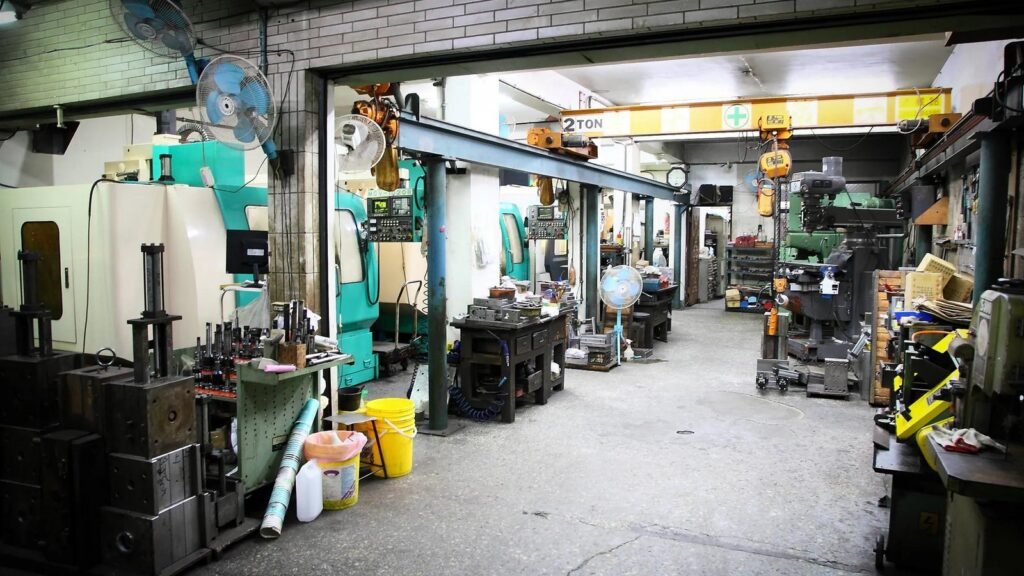

Developing an injection mold in China is the biggest step—and biggest risk—in taking a physical product to market. A good mold runs for hundreds of thousands of parts with consistent quality; a bad mold leaks flash, warps parts, and delays production by months. This guide walks through the entire tooling process, the steel choices, the sample terminology, and how to write the mold scope into your contract.
1. The Full Mold Development Workflow
- DFM review. Design for Manufacturing. The tooling engineer reviews your CAD for draft angles, wall thickness, gate location, and possible defects.
- Mold flow analysis (模流分析). Simulation software predicts fill pattern, weld lines, warpage, and cooling time.
- Mold design. 2D/3D mold layout: cavities, cores, runners, cooling channels, ejection system.
- Steel selection. Choose steel grade based on expected volume and material.
- Machining. CNC milling, EDM (spark erosion), drilling, polishing.
- T1 trial. First shots from the finished mold; inspect samples for defects.
- T2/T3 iterations. Adjustments based on T1 results until samples are approved.
- Mass production. Once samples pass, production begins.
A typical new mold takes 30–60 days from PO to approved T1 sample; complex molds take 90 days.
2. Steel Grades: What to Specify
- P20. Budget pre-hardened steel. Good for low volume (<100k shots). The most common choice.
- 718H. Higher-quality pre-hardened; better polish, medium volume.
- S136 (stainless). Corrosion-resistant, mirror polish. Required for transparent parts or corrosive materials.
- H13. Hot-work tool steel; high volume or high-temperature materials.
Specify the steel grade in your PO—factories sometimes downgrade steel to cut cost, which shortens mold life.
3. T0, T1, T2 Sample Terminology
- T0. The very first trial shots, often with obvious defects (short shots, flash, warping).
- T1. First “official” trial after basic adjustments; the customer receives samples for review.
- T2 / T3. Revised samples after fixing T1 issues.
Expect 2–3 trial rounds for a new mold. Never accept T0 samples as final.
4. Mold Cost, Payment, and Ownership
- Cost. A single-cavity mold runs USD 3,000–15,000; multi-cavity or complex molds run USD 20,000–60,000+.
- Payment milestones. Common structure: 30% on order, 40% on T1 approval, 30% on final sample approval / first production. Never pay 100% upfront.
- Mold ownership. The contract must state that the mold is your property (you paid for it), can be moved to another factory, and carries your name.
- Mold life. Ask for expected shot life (e.g. 500,000 shots) and maintenance responsibility.
5. Writing the Mold Scope Into Your Contract
A good tooling contract should specify: part CAD version, steel grade, cavity count, expected shot life, number of included trial rounds, sample approval criteria, payment milestones, mold ownership, and who pays for shipping the mold. Vague contracts lead to disputes over “extra” trial rounds and mold changes.
Most failed mold projects come from skipping the DFM review—the tooling factory finds problems too late, after machining. Insist on a written DFM report and mold-flow analysis before steel is cut.
6. Mold Storage, Maintenance, and Transfer
Once your mold is approved, it lives at the factory. Protect it contractually: specify that the factory must maintain it, run expected shot-life tests, and store it against rust. If you later want to move the mold to a different factory, the contract must state you can—factories that hold molds hostage are a common dispute. Label every mold with your name, part number, and cavity count, and ask the factory to send photos after each production run. For a brand that plans years of production, the mold is a capital asset—treat it that way, and never let the supplier “forget” who owns it. Budget 5–10% of the mold cost annually for maintenance. When requesting quotes, always provide a 3D STEP file, expected annual volume, target material, and required surface finish (textured, polished, or paint-ready)—without these, quotes are meaningless and vary wildly. For a first mold project, choose a factory with in-house DFM engineers and mold-flow software—the engineering review is worth more than the CNC machining itself.
7. Common Defects Found at T1 Trials
The most common T1 defects are: short shots (incomplete fill), flash (plastic seeping into the parting line), warpage (part bending after cooling), sink marks (indentations from thick sections), and weld lines (visible lines where plastic flows meet). Each defect requires a specific mold adjustment—increasing gate size, changing cooling, adding ribs, or adjusting injection pressure. Expect 2–3 rounds of trial for a new mold; a factory that promises a perfect T1 is usually hiding problems.
8. How to Compare Tooling Quotes
Mold quotes vary wildly for the same part. Compare them by: (1) steel grade and hardness; (2) cavity count; (3) expected shot life; (4) how many trial rounds are included; (5) whether mold-flow analysis is included; (6) who owns the mold. A cheap quote that uses soft steel and one included trial round often costs more in the long run when the mold wears out after 50,000 shots. Choose a factory that itemizes the quote, not a single lump sum.