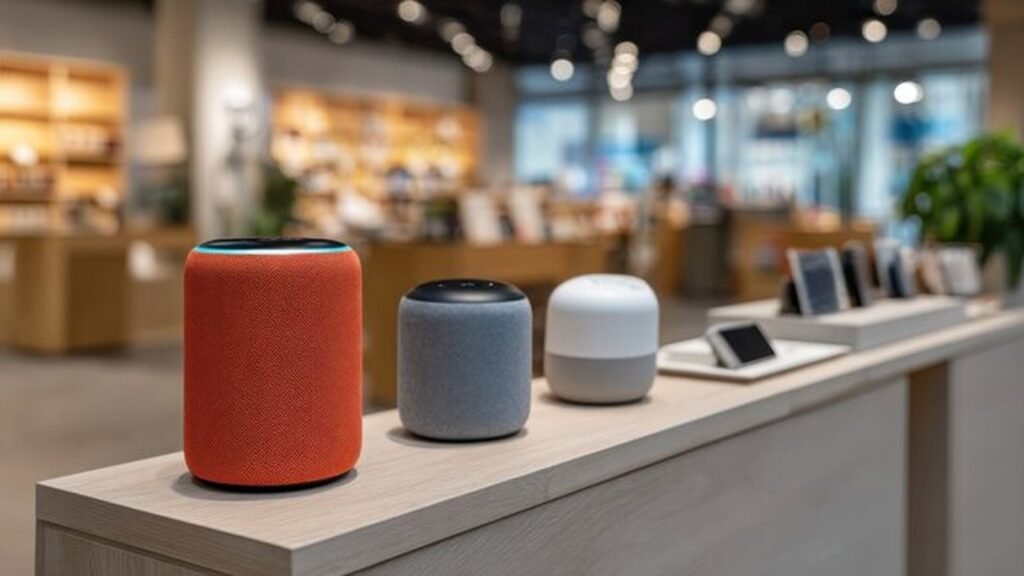

China manufactures the vast majority of smart-home devices—Shenzhen and Dongguan host hundreds of OEM factories that make bulbs, plugs, cameras, locks, and sensors for global brands. For a new brand, the opportunity is large: a smart bulb that retails in Europe for EUR 15 can be sourced FOB for EUR 3–6. But smart hardware is the most compliance-intensive consumer category—wireless certification, energy rules, platform integration, and app maintenance all matter. This guide covers categories, protocols, certification, and OEM options.
1. Product Categories
- Smart lighting. Bulbs, light strips, downlights. The entry-level category; highest volume.
- Smart plugs and switches. Energy-monitoring plugs, wall switches.
- Smart locks. Fingerprint, app, and keypad locks.
- Smart cameras. Indoor/outdoor Wi-Fi cameras.
- Sensors. Motion, door/window, temperature, water-leak sensors.
- Hubs and control panels. Zigbee/Z-Wave gateways, touch screens.
2. Communication Protocols
- Wi-Fi. Easiest setup, no hub needed. Higher power consumption.
- Bluetooth / BLE. Low power; mesh networks for lighting.
- Zigbee. Requires a hub; stable, low-power, professional installations.
- Z-Wave. Popular in North America; requires a hub.
- Matter. The new unified standard that works across ecosystems; increasingly important.
For a new brand, Wi-Fi with optional Matter support is the lowest-friction choice.
3. Certification: The Non-Negotiables
- FCC (US) / CE (EU). Wireless and EMC certification—mandatory for any device with radio.
- UL / ETL (US). Safety certification for plugs and locks; often required by retailers.
- California CEC / DOE energy rules. Efficiency standards for always-on devices.
- RoHS and REACH. EU restricted substances.
- Camera privacy. Increasingly strict; encryption and security audits expected.
Ask the factory which certifications they already hold for your target market—certification re-testing costs USD 5,000–20,000 and weeks of delay.
4. App and Platform Integration
The hardware is only half the product—the app and voice control are the other half. Options:
- White-label app (Tuya/Smart Life). Fastest and cheapest; your branding on a generic app. Good for launch.
- Custom app development. More control, higher cost (USD 10,000–50,000).
- Voice platforms. Alexa, Google Home, and Apple HomeKit integration. HomeKit is the hardest and most expensive to certify.
Most new brands start with a Tuya-based white-label app and Alexa/Google integration, then invest in a custom app later.
5. QC and Clusters
- Connectivity stability. Test pairing, reconnection after power loss, and range.
- Response time. App-to-device command should execute within 2–3 seconds.
- Durability. Power-cycle testing, temperature range, and (for cameras) night-vision checks.
The clusters are Shenzhen (electronics and cameras) and Dongguan (manufacturing). For a first order, choose a factory that already holds FCC/CE for your exact product and offers a white-label app—that is the fastest path to launch.
6. Common Sourcing Mistakes
The most expensive smart-home errors are: choosing a factory without existing FCC/CE certification; launching a custom app before validating demand; ignoring camera privacy and security requirements; and selecting a cheap Wi-Fi module that drops connections. Another trap is firmware—a device that works at launch but receives no updates becomes obsolete. Before bulk production, confirm the factory can provide firmware updates for at least 2–3 years. Start with a Tuya-based white-label device, validate your market, then invest in a custom app and Matter certification once you have real sales. Hardware without good software is a return magnet. A smart bulb that cannot reliably connect to Wi-Fi is returned within days—app reviews are the #1 driver of negative feedback in this category. Always test the device and app from a typical home environment, not just the factory floor. For a practical start, launch a smart bulb and a smart plug on a Tuya white-label app with Alexa and Google integration—this is the lowest-risk entry point.
7. BOM Cost Breakdown
A smart device’s cost is dominated by: the Wi-Fi/Bluetooth module (USD 1–3), the microcontroller (USD 0.5–2), the power supply (USD 1–4), the enclosure (USD 0.5–2), and assembly/testing (USD 0.5–1.5). A smart bulb’s FOB cost is typically USD 3–6; a smart plug USD 4–8; a smart camera USD 10–25. Customizing the enclosure or firmware adds cost but lets you differentiate. Always ask the factory for a BOM breakdown—it reveals where margin is being taken.
8. Warranty, Software Updates, and Returns
Smart hardware has higher return rates than dumb hardware because of connectivity issues. Budget for a 2–3 year firmware update commitment; devices that stop updating become e-waste and generate bad reviews. Insist on a 1-year warranty and a simple returns process. Because software issues cannot be fixed by sending a replacement, invest in good documentation and a responsive support channel—this is what separates a serious smart brand from a drop-shipper. Pricing for a white-label smart bulb is USD 3–6 FOB; a smart plug USD 4–8; a basic Wi-Fi camera USD 10–20. Expect certification costs of USD 3,000–10,000 per device model—factor this into your launch budget.