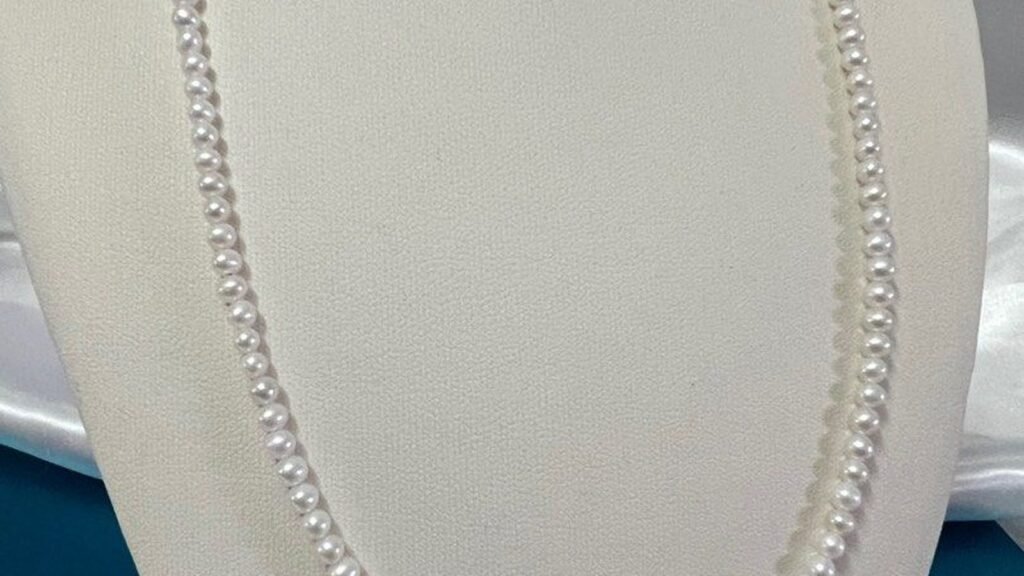

China produces the majority of the world’s freshwater pearls, centered on Zhuji’s Xiahu Lake area in Zhejiang. Sourcing pearls directly from the origin is dramatically cheaper than retail — but it is also a category where grading is subjective and “treated” product is everywhere. This guide explains how pearls are graded, what to watch for, and how to buy with confidence.
Buying in the origin cluster
Shopping in Zhuji means walking through wholesale markets and grading halls where thousands of strands and loose beads are sorted by grade. The advantage is that you can physically compare luster side by side — luster is impossible to judge from a photo or a video call. Build a relationship with one honest sorter rather than hopping between stalls, because consistency of grade between orders matters far more than a single bargain. For repeat buyers, a trusted supplier who sorts to your spec every time beats chasing the lowest price.
Pricing realistically
Pearl pricing is not linear. A slightly rounder, higher-luster strand of the same size can cost several times a mediocre one. Set your target grade and budget before you buy, and decide what “good enough” means for your market — wholesale buyers often overspend chasing top-grade pearls when mid-grade is what their customers actually pay for. Ask for a mixed sample at a few grades so you can see the jump in quality for your money.
Where it comes from
The freshwater pearl industry clusters around Zhuji (Xiahu Lake) and Deqing in Zhejiang, where farms, grading houses and jewelry workshops sit close together. Buying in the origin cluster means access to the whole supply chain: loose beads, strung strands, and setting/processing all in one region.
The four grading factors
Pearl quality is graded on four dimensions:
- Roundness — near-round and off-round are cheaper; perfectly round commands a premium.
- Luster — the mirror-like reflection that makes a pearl look alive; the most important factor.
- Surface / cleanliness — spots, bumps and pits lower the grade.
- Size — larger pearls cost disproportionately more.
Grades are loosely labeled (such as A, AA, AAA) but these labels are not standardized — inspect the actual beads, not the grade sticker.
Loose beads vs strands
You can buy loose pearls (裸珠) to set yourself, or finished strands (串珠) and accessory-made jewelry. Strung strands are already matched for luster and size, which saves grading work but costs more per bead. Loose beads are cheaper but require matching and stringing yourself.
Treated vs untreated, and spotting dyed pearls
Most commercial freshwater pearls are treated (bleached, polished, strengthened) to some degree — that is normal. The concern is dyed or color-enhanced pearls sold as natural. Watch for unnaturally uniform, saturated color, a chalky look under magnification, or a price that is too good to be true. For resale, ask whether treatment is disclosed, and keep the supplier’s documentation.
QC, sorting and price
Because pearls are natural, sorting and matching is real work. Inspect under good light for luster and surface blemishes, and check that a strand is matched for color and size. Price moves with roundness, luster, size and quality — two strands of similar size can differ wildly in value. Pair with local jewelry processing for finished pieces.
Pearl care and setting
Pearls are organic and softer than most gems, so they need gentle handling in setting and everyday wear. If you have pearls set into pendants or rings, use a jeweler experienced with pearls rather than a generic metalworker, because heat and chemicals can damage the nacre. For finished strands, hand-knotting between beads protects them from rubbing and stops the whole strand spilling if it breaks. These finishing details add value and are worth paying for.
The bottom line
Freshwater pearls reward buying at the Zhuji origin and inspecting the actual beads. Grade on roundness, luster, surface and size rather than trusting labels, know what treatment is normal, and be wary of suspiciously uniform color. With local grading and jewelry workshops nearby, the origin cluster is the most efficient place to build a pearl line. Buy on sight, trust a consistent sorter, and match the grade to your market — done that way, freshwater pearls are a high-margin category that customers perceive as luxury. The biggest mistake buyers make is paying top grade for a market that only wants mid-grade — set your target quality to your customer, and let the rest go. A starter order of mixed-grade samples is the fastest way to learn where your money buys the most luster. Once you know your grade, a repeat supplier sorting to that spec every order keeps your strand quality consistent. Buy a small mixed sample first, inspect it under strong light, and let luster — not the grade sticker — decide. That single habit saves buyers more money than any negotiation.