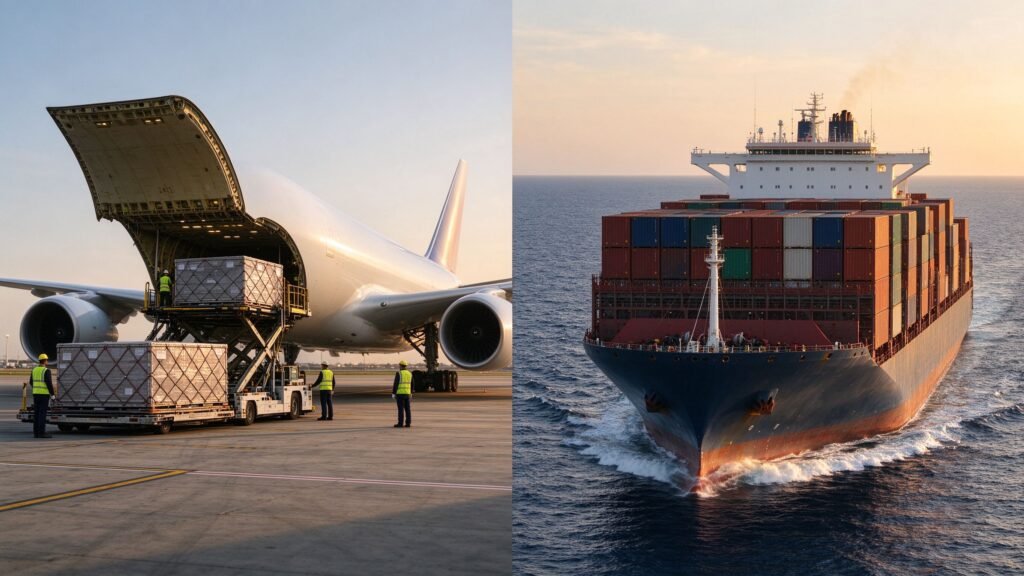
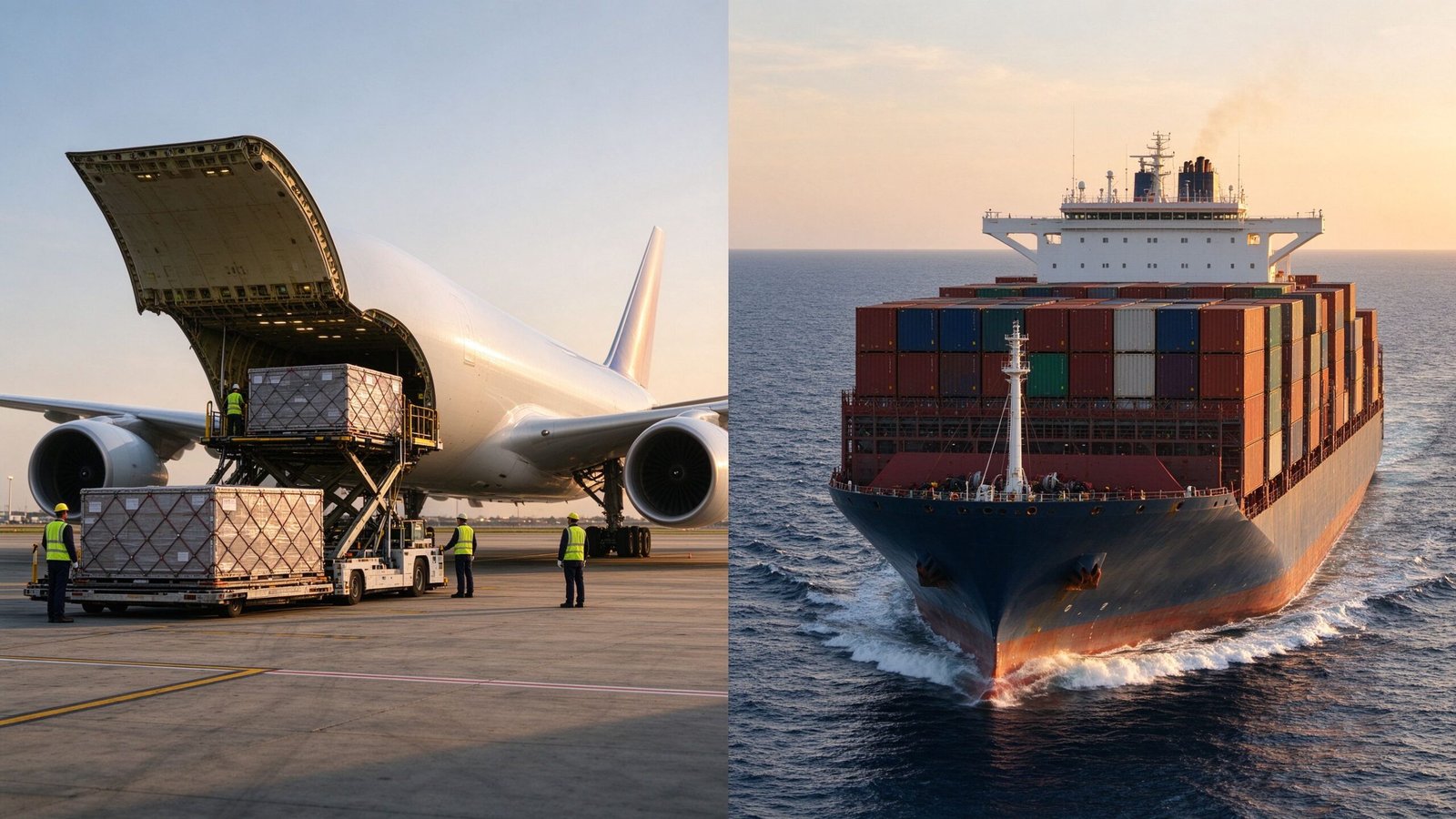
Choosing between air freight vs sea freight is one of the biggest cost decisions you will make when sourcing from China. Pick wrong and you either blow your margin on express charges or lose weeks of selling window waiting on a slow vessel. This guide breaks down real China shipping cost per kilogram and per cubic meter, compares transit times, and gives you a decision framework you can use on every quote.
1. Real China Shipping Cost: Air vs Sea, Per KG and Per CBM
As of 2026, here is what importers are actually paying on the major lanes from Shenzhen/Shanghai to the US West Coast and Western Europe (door-to-door, all-in, excluding duties). Use these as planning numbers — always get a live quote because fuel, peak season and surcharges move prices weekly.
- International express (DHL/FedEx/UPS): roughly USD 6–9 per kg door-to-door to the USA. Best for samples and urgent 50–200 kg shipments.
- Air freight (consolidated, airport-to-airport): roughly USD 4–6 per kg to US airports, plus USD 1–2 per kg for last-mile trucking. All-in door-to-door typically USD 6–8 per kg.
- Sea LCL (less-than-container, door-to-door): roughly USD 80–150 per CBM plus a bill-of-lading fee of USD 100–150 per shipment. Cheapest only when your cargo exceeds ~2 CBM.
- Sea FCL 20ft container: roughly USD 1,500–3,500 door-to-door to US West Coast in normal market conditions; 40ft HC roughly USD 2,500–5,500.
- Cost break-even point: below ~300 kg, air is often cheaper than LCL once you factor in pickup, documentation and destination fees. Above ~500 kg, sea LCL starts winning.
A useful rule: compare on a per-kg landed basis, not per shipment. A 500 kg LCL shipment that looks cheap on paper can end up more expensive than air once warehouse handling, CFS fees and customs clearance are added.
2. Transit Time: Air 3–7 Days vs Sea 15–40 Days
Speed is where the two modes diverge most. Plan backwards from the date your goods need to be on the shelf, not from the day the supplier finishes production.
- Air freight door-to-door to USA: 5–8 days total (1–2 days factory pickup + 1 day consolidation + 2–4 days flight + 1–2 days customs + 1–3 days last mile). Express courier door-to-door is 3–5 days.
- Sea LCL door-to-door to US West Coast: 25–35 days. To US East Coast via Panama: 35–45 days. Europe (Rotendorf/Hamburg): 28–38 days.
- Sea FCL door-to-door to US West Coast: 18–25 days after vessel departure, plus 3–7 days for port, customs and drayage. Full cycle from factory gate to your door is typically 25–35 days.
- Seasonal delays: avoid booking August–October at spot rates; blank sailings and port congestion during peak season can add 7–14 days.
If you are running Q4 promotions on Amazon or Shopify, the cut-off date for sea freight from China to the US is usually mid-September. After that, air is the only safe way to hit Black Friday.
3. When to Choose FCL, LCL or Air Freight
The right mode depends on cargo density, value density and urgency. Here is a practical decision matrix used by experienced importers:
- Choose air freight when: cargo is under 300 kg, value per kg is high (electronics, accessories, fashion restocks), or you have a hard selling deadline. Low-value, heavy, bulky goods almost never justify air.
- Choose LCL sea when: cargo is 2–15 CBM, you can wait 4–6 weeks, and the goods are not time-sensitive. Ideal for first test orders that are too big for air but too small for a full container.
- Choose FCL 20ft when: you can fill roughly 28 CBM or 10,000 kg — or when your goods are sensitive and you do not want them handled alongside other shippers’ cargo.
- Choose FCL 40ft HC when: cargo volume is 55–68 CBM and density is low (pillows, plastic goods, furniture). Per-kg cost drops dramatically.
- Special cases: oversized or overweight cargo (machinery, cars) goes by breakbulk or RORO. Dangerous goods (batteries, liquids) need DG-approved air or sea booking — factor in extra 5–10% surcharge.
4. Hidden Costs That Blow Up Your Shipping Budget
Most first-time importers compare only the headline rate and get burned by add-ons. Demand an all-in quote that explicitly lists:
- Origin pickup, export customs declaration and documentation fees.
- Terminal handling charges (THC) at both origin and destination.
- CFS (container freight station) fees for LCL, charged per CBM at both ends.
- Security fees, AMS/ISF filing for US-bound cargo, and tax (VAT/IOSS for EU).
- Detention and demurrage if your container sits at the port too long — these can run USD 150–300 per day.
- Oversize / over-weight surcharges and fuel adjustment factors (BAF).
Always ask the forwarder: “Is this quote door-to-door, all-in, excluding duties?” Get it in writing. A cheap quote that excludes destination charges is rarely a cheap quote.
Final Recommendation
There is no single correct mode — there is the correct mode for this shipment. As a starting point: samples and urgent restocks go by express; 100–500 kg time-sensitive cargo goes by consolidated air; test orders of 2–15 CBM go by LCL; repeat bulk orders go by FCL. Build a shipping calendar that mixes modes by SKU so you never run out of stock on your best sellers while avoiding air freight costs on slow-moving items. For more detail on how these costs feed into your landed price and how to negotiate with forwarders, explore our China procurement guides covering everything from supplier selection to customs clearance.