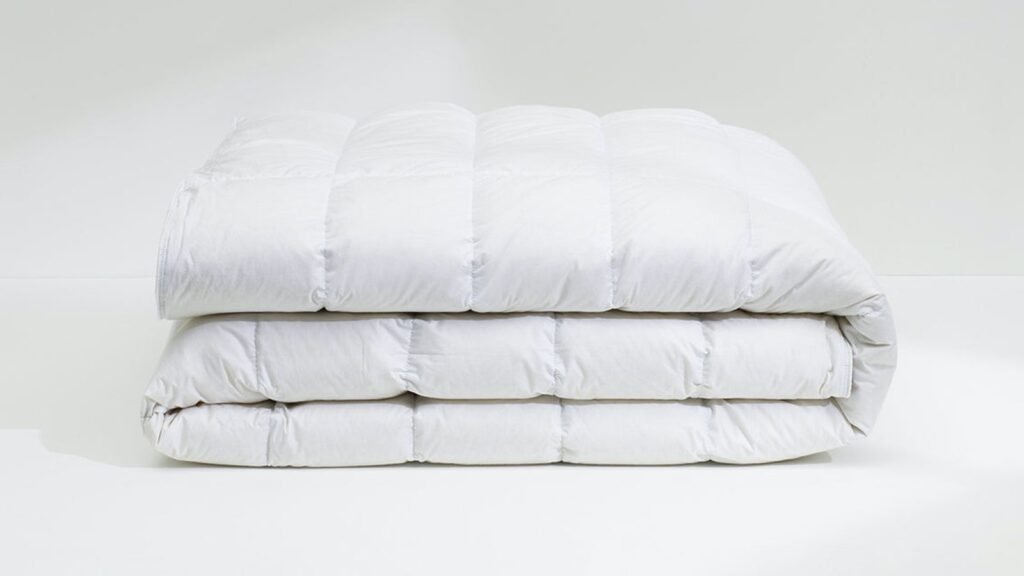

Down duvets are one of the highest-margin home-textile categories—and one of the most technically demanding to source. A premium goose-down duvet that retails in Europe for EUR 300–800 can be sourced FOB for EUR 40–100. But the category is full of traps: duck down sold as goose, low fill power dressed up as premium, and cheap shells that leak feathers after a few weeks. This guide explains the specs that actually matter and how to verify them.
1. Down Type: Goose vs Duck, and What the Numbers Mean
- Goose down. Larger clusters, higher fill power, more durable, better loft. Premium.
- Duck down. Smaller, cheaper, slightly less loft. The mid-market standard.
- Fill Power (FP). A measure of loft: 550 FP is mid-range, 650–750 FP is premium, 800+ FP is luxury. Higher FP means warmer with less weight.
- Down content (绒子含量). The percentage of pure down clusters vs feathers. Premium duvets are 90% down / 10% feather; budget ones are 50/50.
Always ask for a lab report that measures fill power and down content—these cannot be judged by eye.
2. Shell Fabric: The Anti-Leakage Layer
A duvet is only as good as its shell. A cheap shell leaks feathers; a good shell does not.
- Fabric count. 233–400 thread count cotton is standard. Higher count = tighter weave = less leakage.
- Down-proof finish. A special coating that blocks quills from poking through.
- Weight. 60–80 gsm cotton shell is typical; lightweight shells breathe better.
3. Construction: Baffle Boxes vs Stitch-Through
- Baffle box (格子立衬). Internal fabric walls keep down evenly distributed and prevent cold spots. Premium method.
- Stitch-through (锁边). Quilted channels; cheaper but allows down to migrate and creates cold spots at the seams.
For a premium product, specify baffle-box construction.
4. QC: The Tests That Protect Your Brand
- Down leakage test. Rub the shell; no quills should poke through.
- Fill power measurement. A lab test that confirms the advertised FP.
- Cleanliness / overfill. Down must be washed and sterile; a bad batch smells dusty. Ask for cleanliness ( turbidity ) test.
- Fill weight accuracy. Weigh the duvet; it must match the stated fill weight.
- Stitch quality. Even stitching, no loose threads, strong corner ties.
5. Certifications: RDS and OEKO-TEX
- RDS (Responsible Down Standard). Certifies down is collected without live-plucking or force-feeding. Required by most Western retail brands.
- OEKO-TEX Standard 100. Shell fabric safety; limits chemicals and formaldehyde.
- Import cleanliness rules. Many countries require proof that down is clean and pest-free.
6. Clusters and Pricing
Major down-bedding clusters: Xiaoshan (Zhejiang), Lu’an (Anhui), and parts of Jiangsu. Realistic FOB: a 90% goose 650 FP queen duvet runs USD 40–90 FOB depending on shell fabric. MOQ is typically 200–500 pcs per SKU. Because down quality varies batch to batch, always request a lab-tested sample and compare it against the production lot.
6. Common Sourcing Mistakes
The most expensive down-sourcing errors are: paying goose-down prices for duck down; accepting a fill-power claim without a lab report; using a cheap shell that leaks feathers; and ordering mixed fill weights across duvets. Another trap is “overfilled” marketing—a duvet stuffed with low-quality feathers feels heavy but is not warm. Insist on the fill-power lab report, not the marketing label. For a new brand, start with a mid-spec 90% duck 650 FP duvet to prove demand, then move to goose and 750 FP once sales justify the cost. Always request the fill-power lab report, not just the marketing label. A 90/10 goose 650 FP queen duvet weighs roughly 1.2–1.5kg of fill; a 90/10 goose 800 FP luxury duvet uses 800–1,000g of fill but is warmer. The tog rating (UK) or fill weight is how consumers compare products—specify both. For a practical start, order a 90/10 duck 650 FP all-season duvet and a 90/10 goose 800 FP luxury duvet; these two SKUs cover most of the market.
7. How to Evaluate a Down Sample
When a duvet sample arrives, do three things: (1) compress it firmly—a premium duvet springs back instantly; (2) rub the shell with your palm—no quills should poke through; (3) smell it—clean down has no dusty odor. Weigh it against the advertised fill weight. If it passes these, request the lab report for fill power and down content. A sample that feels heavy but does not loft well is likely filled with feathers, not down.
8. Packaging, Labelling, and Seasonality
Down duvets are usually vacuum-packed for shipping—this saves freight but must be fluffed for 24–48 hours before retail. Specify the size tag, fill weight, care label, and RDS/OEKO-TEX logos on the packaging. Demand is strongly seasonal: orders for Q4 must be placed by June–July to allow sea freight. Start with an all-season SKU, then add winter-weight once you understand your market.