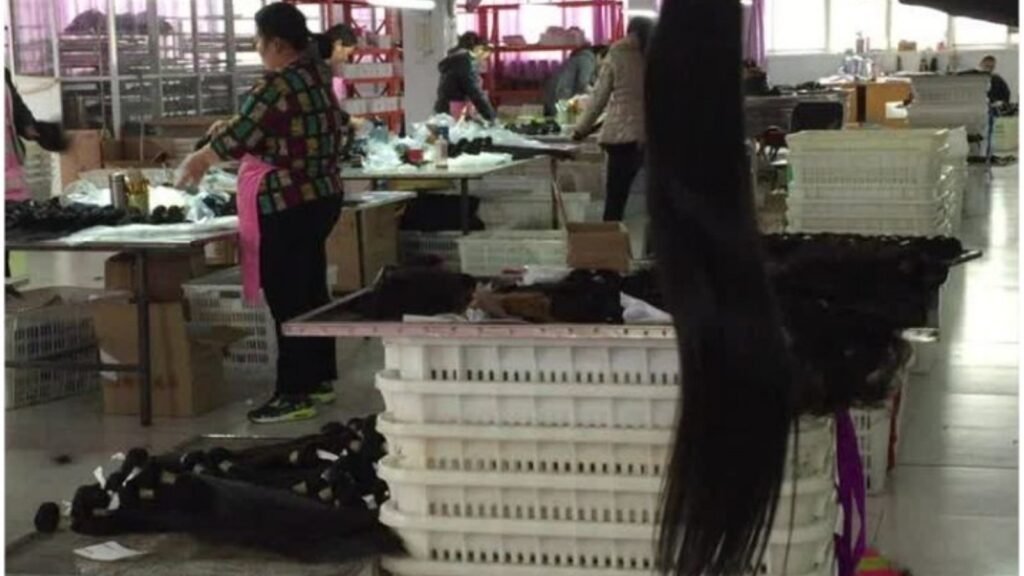

China supplies the majority of the world’s human-hair wigs and extensions—Xuchang in Henan alone is a global hub. For beauty brands, the margin on hair products is enormous: a bundle that retails in the US for USD 80–150 can be sourced FOB for USD 15–40. But hair sourcing is also one of the easiest categories to get wrong: mislabeled synthetic hair sold as human hair, tangling after a few washes, and shedding from a poorly constructed cap. This guide covers categories, grades, QC, and the clusters.
1. Real Hair vs Synthetic Hair
The first decision is material:
- 100% human hair. Can be heat-styled, dyed, and lasts 1–3 years with care. Sold as bundles, closures, frontals, and full wigs.
- Synthetic hair (kanekalon etc.). Cheap, pre-styled, but cannot be heat-styled and looks shiny. Budget-only.
- Blends. A small percentage of synthetic mixed in to cut cost—avoid for premium brands.
Always require a burn test or lab confirmation: human hair burns to ash with a smell like burnt hair; synthetic melts into a hard ball. Reputable factories provide this on request.
2. Human Hair Grades: What the Labels Actually Mean
Hair grading is confusing and often marketing. The key distinctions:
- Virgin / raw hair (原发). Unprocessed, single-donor hair, cut in one direction. Highest grade, longest life.
- Remy / remi hair (顺发). Cuticles kept aligned; may be acid-washed and colored. Very common mid-premium grade.
- Non-remy / processed hair (泡发). Cuticles stripped, then coated with silicone to look shiny. Tangles and sheds after the silicone washes off—the classic “cheap hair” trap.
- Double-drawn vs single-drawn. Double-drawn means the hair is sorted so all strands are the same length, giving a full, blunt end. Single-drawn has varying lengths. Double-drawn commands a premium.
Ask the supplier which grade they are quoting—do not accept vague terms like “10A” without a sample.
3. Wig Construction: Machine vs Hand-Tied, Lace Type
- Machine-made wefts. Hair sewn onto a mesh cap by machine. Cheaper, sturdier, but less natural at the hairline.
- Hand-tied (hand-knotted) lace wigs. Individual strands knotted onto a lace cap. The most natural look—required for premium brands.
- Lace type. Transparent lace, HD lace, or Swiss lace. HD lace is thinnest and most undetectable; it is also more fragile.
- Closure vs frontal vs full lace. A closure covers a small section; a frontal runs ear-to-ear; a full lace wig covers the whole head.
4. QC: The Defects That Kill the Sale
- Shedding. Shake the bundle; excessive loose hair means weak wefts or poor processing.
- Tangle test. Comb the hair from tip to root 20 times; premium virgin hair should not tangle.
- Density. Specify density (130%, 150%, 180%). A 150% wig should look full but not heavy.
- Cap fit and comfort. The adjustable straps and combs should feel secure; lace should not itch.
- Color match. For colored hair, compare swatches under natural light—factory batches can vary.
5. Clusters, Pricing, and MOQ
- Xuchang (Henan). The global wig and hair-extension capital; covers all grades and price points.
- Taihe (Anhui). Strong for hair processing and mid-market bundles.
- Qingdao (Shandong). Export-oriented, often higher-quality factories serving Western brands.
Realistic MOQ: bundles start at 1–5 bundles per length/color; lace wigs at 50–100 pcs per style. Samples cost USD 30–80. Because hair is a natural product, always order a small lot first and test it through a real wash-and-style cycle before scaling.
6. Common Sourcing Mistakes to Avoid
The most expensive hair-sourcing errors are: paying for “virgin” hair that is actually processed non-remy; skipping the burn test; accepting a sample but not a production-matched sample; and buying a cheap lace cap that breaks within weeks. Another common issue is color inconsistency—two bundles from the same order can arrive slightly different shades. Mitigate this by ordering all bundles in the same lot number and asking the factory to inspect color consistency before packing. For a brand, hair quality is everything: a single bad batch of tangling, shedding hair destroys reviews far faster than in any other category. Order small, test thoroughly, and only scale once you trust both the hair grade and the factory’s consistency. Pricing for real virgin double-drawn bundles typically runs USD 25–50 per 100g; lace closures USD 20–60; full lace wigs USD 80–250 depending on density and lace type. Synthetic wigs under USD 10 are almost always low quality and should not be sold under a brand name. For a practical first order, choose two proven styles (straight body wave and curly), specify virgin remy hair, order 100–300 bundles, and test color and shedding before reordering.
7. How to Request and Evaluate Samples
Always order physical samples before placing a bulk order—do not rely on factory photos. Ask for: (1) a bundle in your chosen length and texture; (2) a small swatch of the lace cap; (3) a sample washed and blow-dried to see how it holds up. When the sample arrives, run the burn test, the combing test, and the color check under both natural and artificial light. If the sample passes, place a 100–200 piece trial order and repeat the same tests on the production lot. Only scale once you are confident the factory can reproduce the sample consistently.