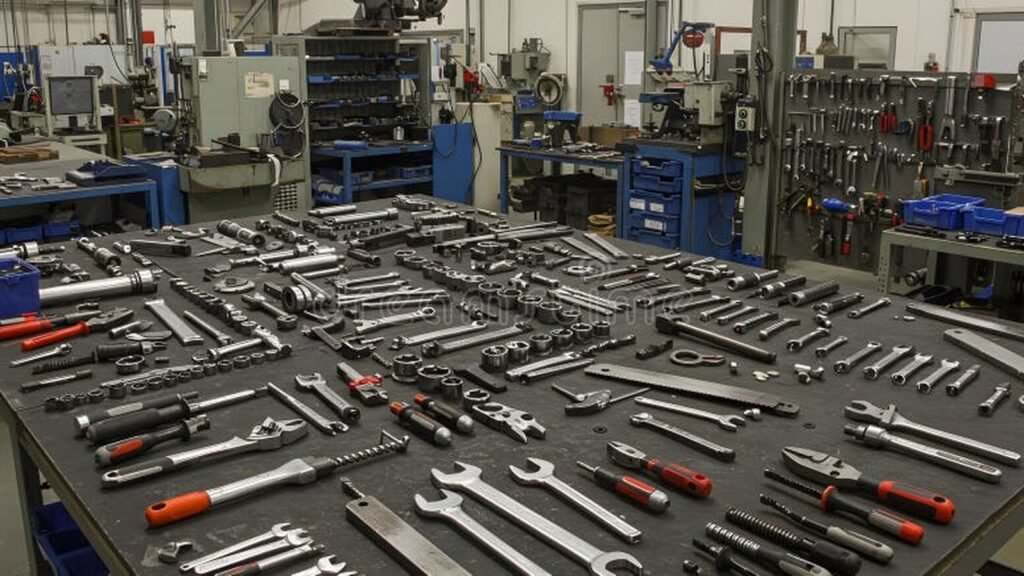

China supplies the majority of the world’s hand tools, power tools, fasteners, and locks. Yiwu, Yongkang, and Danyang are the classic hubs; Shenzhen and Dongguan dominate power tool OEM. The opportunity is obvious—a ratchet wrench that retails in the US for USD 25 can be sourced FOB for USD 3–5. But tools are safety-related products: a snapped screwdriver, a mis-rated bolt, or a lock that fails on a customer’s front door generates liability, not just returns. This guide covers what to source, how to certify it, and how to run private-label OEM correctly.
1. Product Categories and Where They Are Made
- Hand tools. Wrenches, sockets, screwdrivers, pliers, hammers, tape measures. Yongkang and Jinhua (Zhejiang) are the global cluster. Most are chrome vanadium (Cr-V) steel, heat-treated.
- Power tools. Drills, angle grinders, impact drivers, sanders. Dongguan and Suzhou host OEM factories for Bosch, Makita, and Milwaukee-style clones. Battery platforms (18V/20V Li-ion) are the dominant export format.
- Fasteners. Bolts, nuts, screws, anchors. Hebei (Yongnian) and Zhejiang. Material grades (4.8, 8.8, 10.9, A2/A4 stainless) must be specified by property class, not just appearance.
- Locks and door hardware. Cylinder locks, smart locks, padlocks. Wenzhou and Guangdong. Smart locks require battery, RF, and often Bluetooth/Wi-Fi certification.
2. Materials and Heat Treatment: Why Grade Matters
Cheap tools fail because of cheap steel. For hand tools the accepted alloy is chromium-vanadium (Cr-V, e.g. 50CrV4); impact tools such as sockets and breaker bars often use chromium-molybdenum (Cr-Mo). Ask the factory:
- For a material certificate (EN 10204 3.1) showing alloy composition.
- For a hardness test report—wrenches typically 38–48 HRC; screwdriver tips harder but not brittle.
- For a torque / proof-load test—a ratchet wrench should not deform at 1.5× its rated torque, and sockets should not crack.
For fasteners, specify property class on the PO (e.g. “Grade 8.8 hex bolt, zinc-plated, ISO 4014”). A “similar” bolt that is actually Grade 4.8 under load is a safety hazard.
3. Certification: Which Marks Are Mandatory
- CE marking. Mandatory for power tools sold in the EU, covering the EMC Directive, Low Voltage Directive, and (from 2024) the new Ecodesign / Battery regulation. It is self-declaration based on EN test reports—ask for the actual EN 60745 / EN 62841 test report.
- GS mark (Geprüfte Sicherheit). Voluntary but highly valued in Germany and Northern Europe. Issued by a third party such as TÜV or Intertek. If you sell to German DIY retailers (Obi, Hornbach), expect GS to be required.
- UL / ETL. For power tools and chargers sold in the US. UL standards for portable electric tools include UL 60745 and UL 62841; battery packs need UL 2056 / UL 2743.
- ANSI / ASME. Hand tools are commonly tested to ANSI/ASME B107 series (drives, wrenches, sockets). If you sell to North American industrial users, ask for an ANSI B107 torque test report.
- RoHS and REACH. Restricts lead, cadmium, phthalates, and certain plasticizers in handles and grips—mandatory for EU sales.
- FCC Part 15. For power-tool battery chargers and smart locks with wireless modules sold in the US.
4. Quality Control: Dimensions, Hardness, and Torque
A professional pre-shipment inspection for tools should include:
- Dimensional check—socket sizes match their marking (a 10mm socket must actually be 10mm), wrench opening tolerance, thread fit.
- Hardness test—with a portable Rockwell or Vickers tester on a sample of units.
- Torque / proof-load test—at the factory or a lab, run on a sample of wrenches and sockets at rated and 1.5× rated torque.
- Salt spray test—zinc-plated tools should survive 24–48 hours neutral salt spray without red rust.
- Function test—ratchet engagement, screwdriver tip fit, plier jaw alignment, power tool no-load run and load test, battery charge/discharge cycles.
- Labeling—country of origin, CE/UL logos, rated voltage/wattage, model number matching the user manual.
5. OEM / ODM Private Label and Packaging
Most Chinese tool factories welcome private-label orders with low MOQs:
- Hand tool sets: MOQ 500–1,000 sets for a custom color and logo; 2,000–3,000 for custom plastic case molding.
- Power tools: MOQ 500–1,000 pcs for color/label customization; custom mold (handle shape, battery housing) usually 3,000+ pcs plus mold fee.
- Fasteners: MOQ is usually 1–3 tons per size for custom packaging.
Do not overlook the color box. In hardware, packaging is 50% of the perceived value. A 5-color offset-printed full-color box with a hanging hole costs USD 0.6–1.5 per unit and is the difference between a USD 3 tool that sells for USD 15 and one that sells for USD 6. Ask the factory to send a physical box proof before mass printing, and verify that the English copy, barcode, and regulatory marks (CE/UL/ANSI) are typeset correctly—broken English on a retail box is an instant turn-off.
6. A Practical First-Order Playbook
- Choose 2–3 factories in the relevant hub; request samples and a full spec sheet including steel grade and test reports.
- Order a paid sample, run (or have a lab run) torque and hardness tests against the published ANSI/EN standard.
- Confirm CE/GS/UL/ANSI certificates with report numbers; verify on the issuing lab’s database.
- Approve the color box proof in writing.
- Run a pre-shipment inspection (AQL 2.5) before the container leaves.