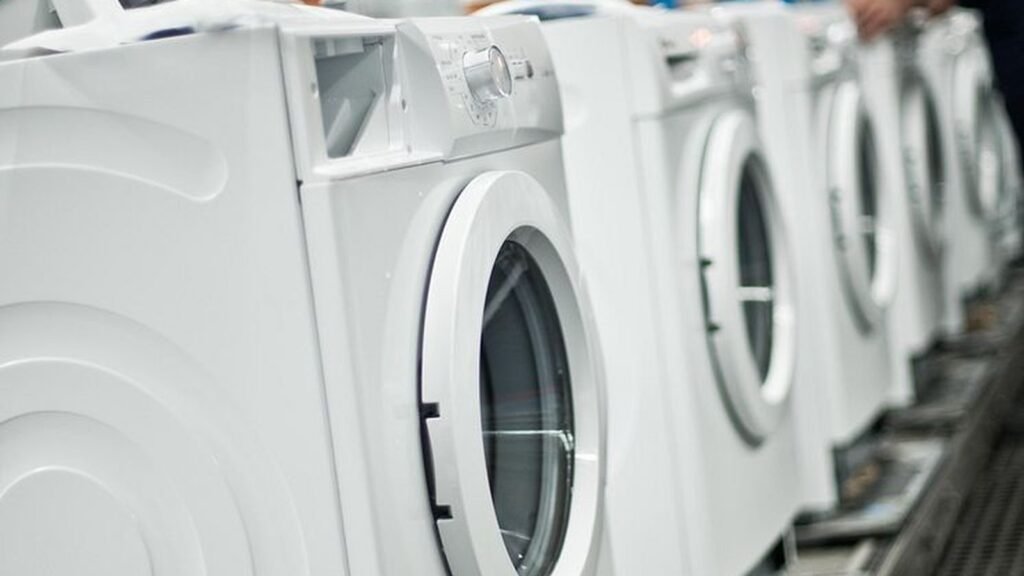

China is the world’s home-appliance factory: refrigerators, washing machines, air conditioners, microwaves, rice cookers, air fryers, and vacuum cleaners. The category is attractive for private-label brands, distributors, and marketplace sellers, but it is also one of the most certification-heavy and QC-demanding categories you can import. A single safety failure on a mains appliance creates liability. This guide covers the range, the energy labels, the certifications, the QC tests, and where the factories are.
Product Categories
- Large appliances: refrigerators, freezers, washing machines, dryers, air conditioners, stoves.
- Kitchen small appliances: microwaves, rice cookers, blenders, air fryers, coffee machines, kettles.
- Cleaning appliances: vacuum cleaners, robot vacuums, steam mops.
- Personal comfort: fans, heaters, humidifiers, dehumidifiers.
Energy Labels You Must Meet
Energy efficiency is not optional — it is the label that determines whether your product can be sold in the market.
- United States: ENERGY STAR is voluntary but demanded by retailers and utilities; FTC appliance labeling rules apply.
- European Union: the new EU energy label (rescaled A–G) applies to refrigerators, washing machines, dishwashers, TVs, and air conditioners. The label must be on the product page and packaging.
- Other markets: UAE, Saudi, and Australia have their own efficiency programs.
Certifications by Market
- United States: UL or ETL safety listing is effectively required for retail; DOE efficiency standards apply.
- Europe: CE marking (LVD + EMC + RoHS + REACH); GS mark for Germany is a strong commercial signal.
- UK: UKCA.
- Australia: RCM mark.
- Japan: PSE.
- Wireless models: additionally FCC/CE-RED for the radio module.
Ask for the actual certificate with the product model number. A certificate for a similar but different model does not cover your product.
QC: The Safety Tests That Matter
- High-potential (hipot) test: electrical insulation withstands high voltage — a failed hipot means shock hazard.
- Grounding continuity and leakage current.
- Temperature rise test: surfaces and internal components under full load.
- Functional tests: thermostat, timer, motor, and safety cutoffs.
- Drop test and packaging: appliances are heavy; packaging must survive international freight.
- Noise test: for washing machines and vacuums, dB rating is a selling point.
OEM/ODM, Clusters, and After-Sales
Most large-appliance factories in Guangdong (Shunde, Foshan), Anhui (Hefei), and Zhejiang support OEM with your logo, and ODM with minor design changes. Tooling for a dedicated exterior can add tens of thousands of dollars. For small appliances, the cluster in Zhejiang and Guangdong lets you combine components fast.
After-sales is the hidden cost. Appliances fail at a low rate but each failure generates a warranty return. Ask the factory about spare-part supply, typical failure rates, and whether they provide service manuals. For private-label, pre-position a small stock of common spares (power cords, heating elements) in your destination market rather than shipping replacements from China under warranty.
Choosing OEM Versus a Turnkey Private Label
Home appliance factories in Shunde, Hefei, and Ningbo typically offer three service levels. Plain OEM means you take an existing model, change the logo, and accept the factory’s existing certifications. Private label ODM lets you change housing color, packaging, manuals, and the user interface language. Custom design means new tooling, a dedicated mold, and fresh certification — only justified at volumes of tens of thousands per model.
A common trap is to assume that because two appliances look similar they are interchangeable. Compressors, motors, heating elements, and electronic controllers are category-specific BOMs. Ask the factory for the actual bill of materials and for the brand of the core components: a named compressor (for a fridge) or motor (for a washer) is a much better signal than a generic listing.
For small kitchen appliances, energy and safety tests are simpler than for large appliances, but the failure modes are different: overheating heating plates, leaking water tanks, and short-lived motors. Budget for a 2–3% warranty reserve on every shipment. Appliances are bought once every few years; a bad first experience loses the customer permanently.
Finally, calculate the true landed cost before you commit. Appliances are heavy, so ocean freight and inland trucking can equal or exceed the product FOB price. A $40 washing machine that weighs 65 kg may cost $30–$40 to move from Shanghai to your warehouse. Include duty, VAT, certification amortization, warranty reserve, and packaging engineering — then compare that number with the retail price of incumbents. Appliances reward scale; small first orders are useful for sampling, not for profitable volume.
A pre-shipment inspection by an independent third party, with hipot and leakage testing on a sample, is the cheapest insurance you can buy for a mains-powered appliance.
For small appliances, the margin case is usually stronger: lower tooling, faster certification cycles, and lighter freight make them easier to test with a private-label launch before committing to a large appliance program.
Plan the private-label launch with a small first order of one or two SKUs; success in small appliances validates the supply chain before you commit to large appliance tooling.