
Kitchenware is one of China’s most mature export categories — cookware, cutlery, utensils, storage and small appliances all flow out of industrial clusters in Guangdong and Zhejiang. The complication is that it touches food, which puts it under food-contact safety rules. Get the materials and the compliance paperwork right, and kitchenware is a repeatable, private-label friendly category.
Which material fits your product
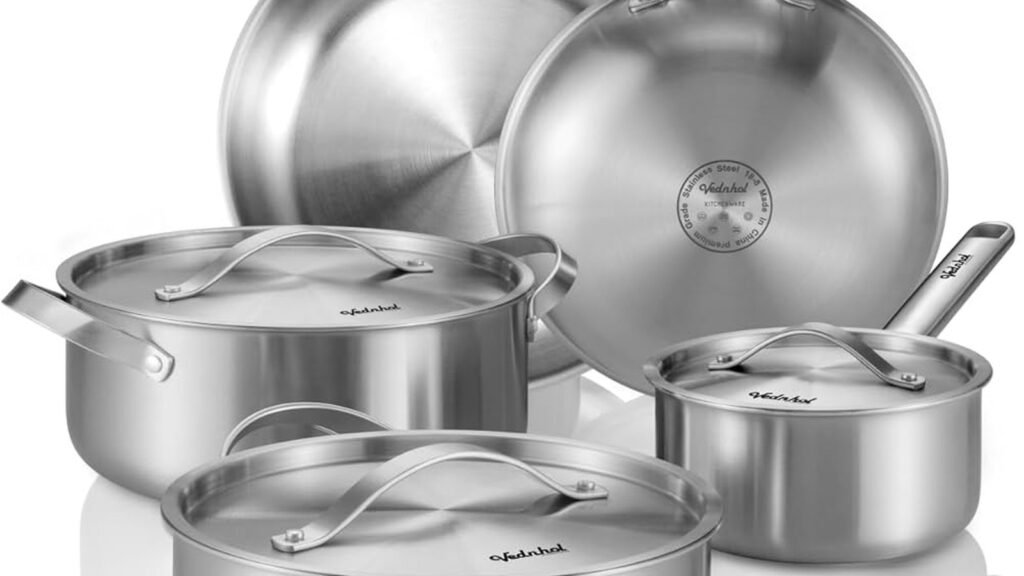
Match the material to how the customer actually cooks. Stainless steel is durable, oven-safe and dishwasher-friendly but can hot-spot without an aluminum core; a tri-ply (stainless-aluminum-stainless) construction solves that and commands a premium. Non-stick cookware is easiest to sell but carries the coating-compliance burden and the expectation of easy release. Cast iron is heavy, low-cost and naturally non-stick when seasoned, but needs careful packaging against breakage. Silicone tools are cheap, flexible and food-safe, and a natural add-on category. For storage containers, plastic (Tritan/PP) and stainless are the usual choices, both subject to food-contact rules.
Cost structure and pricing
Cookware price is driven by material gauge, coating brand (licensed coatings cost more but sell better), and the number of pieces in the set. When comparing quotes, separate the unit cost, the coating upgrade, packaging, and any logo/gift-box cost — a cheap base pan with a premium coating can be more profitable than a bare cheap one. Because cookware ships bulky and dents easily, knocked-down packaging and protected corner foam are worth paying for to avoid arrival damage claims.
Categories and materials
- Cookware — stainless steel, non-stick coated, cast iron and aluminum. Each has a different cost, use and compliance angle.
- Cutlery and utensils — stainless steel knives and spoons, silicone tools, wooden items.
- Storage and small electrics — food containers plus small appliances, where electrical certification joins food-contact rules.
Food-contact compliance
Because these materials touch food, they must meet the destination’s food-contact requirements. In the US that means compliance with the relevant FDA food-contact expectations; in the EU, the framework is the EU food-contact materials regulation framework (with specific migration limits and the Declaration of Compliance). For non-stick coatings, buyers increasingly ask about PFOA/PFAS-free claims. Require supplier test reports for food-contact migration on the actual material, not a general certificate.
QC: coating, thickness and handles
- Coating adhesion — non-stick coating should not flake or scratch off easily; test with a cross-hatch or abrasion check.
- Metal thickness — thin stainless warps and hot-spots; verify gauge against spec and compare weight to the approved sample.
- Handles and joints — handles must be firmly attached, stay cool, and feel solid; loose handles are the most common complaint.
Also inspect packaging, since cookware dents and scratches easily in transit.
Common defects buyers miss
The most frequent kitchenware complaints are subtle: a non-stick pan that releases well on day one but chips within months, a stainless pot that warps on the first hot burner, or a handle that loosens after a few uses. These are not caught by a visual inspection — they come from too-thin metal, weak coating adhesion and insufficient riveting. This is why approving a physical sample and cooking with it beats reading a spec sheet. Check the handle attachment by hand, weigh the pan against your target gauge, and run a quick coating abrasion test before bulk.
Compliance documentation to collect
Ask the supplier for the food-contact migration test report on the exact material and color you are ordering, the Declaration of Compliance where the EU applies, and coating documentation (including any PFOA/PFAS-free claim backing). For small electrics, add the electrical safety and EMC reports. Keep these on file — market surveillance can ask for them, and a documented file is what protects you if a product is questioned.
Sets and private label
Kitchenware sells extremely well as coordinated sets (pots and pans, utensil blocks), which also raises order value. Private labeling — your logo, gift box and colorway — is standard, with MOQs usually in the hundreds per set. Bundling components from the same cluster keeps cost and quality consistent.
Kitchenware certifications to watch
Beyond food-contact migration, remember that small electric kitchen appliances need their own safety and EMC certification, and that certain non-stock coating claims need backing. If you sell into California, Proposition 65 notices may also apply to materials and coatings. The practical move is to ask the supplier up front which destination markets they already export to — a factory experienced in your market already has the right paperwork, which saves you both testing time and cost.
The bottom line
Kitchenware sourcing is about materials plus food-contact proof. Specify steel gauge and coating type, demand FDA/EU food-contact test reports for the actual material, and QC coating adhesion, thickness and handles before shipment. Bundle into sets and private-label once a core product is proven. Because kitchenware is repeat purchase rather than trend-driven, a strong set that customers trust will reorder for years.