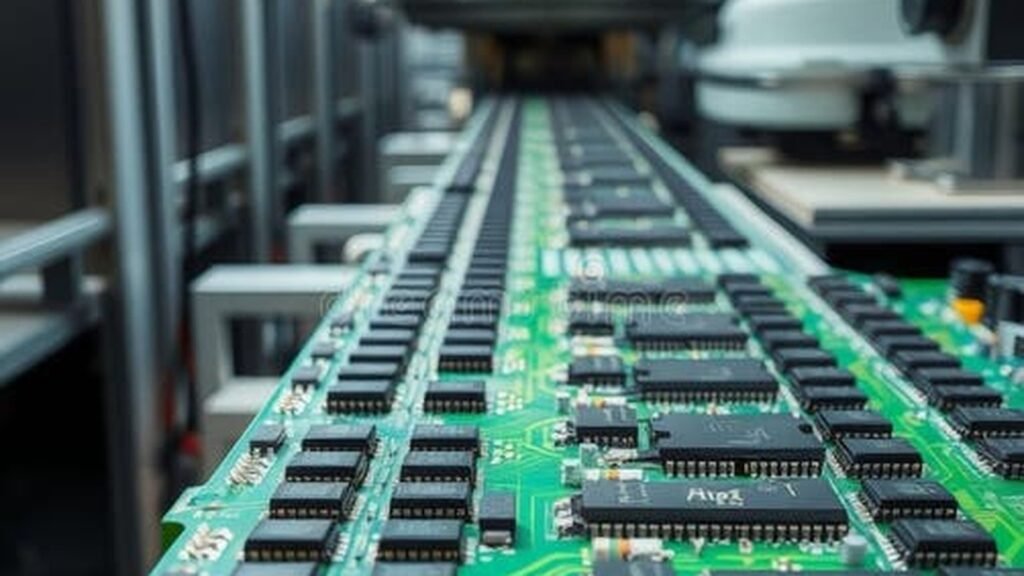

Almost every electronic product starts as a bare board: the printed circuit board (PCB) that everything else is soldered onto. Sourcing boards from China — especially around Shenzhen and Huizhou — is both fast and remarkably cheap, but only if you speak the language of layers, materials and surface finishes. Vague requests produce boards that do not match your design. This guide walks through how PCBs are specified, how prototyping works, and what makes a good quote.
Why Shenzhen and Huizhou
The Pearl River Delta around Shenzhen and Huizhou is the world’s densest PCB ecosystem. Fabrics, laminates, drilling, plating and testing all sit within a short drive, which is why quick-turn samples that take weeks elsewhere arrive in days here. This density also means you can compare many fabs fast — from low-cost prototype houses to high-reliability shops handling multi-layer and impedance-controlled boards. The trade-off is that cheap prototype shops vary widely in quality, so the first build is a chance to learn a shop’s real standards, not just its price.
Working with the fab on your design
Treat your PCB fab as a partner, not a print shop. Send clean, complete Gerbers with a clear stack-up, and respond to the EQ thoroughly — every clarification prevents a wrong first batch. If your design has controlled impedance or dense BGA parts, tell the fab up front so it confirms its process can support it. A small extra sample order to validate a new design is cheap insurance before a full production run.
Types of PCB
- Single and double-sided — the cheapest, for simple low-complexity circuits.
- Multi-layer (4, 6, 8+ layers) — for denser, higher-speed products.
- Metal-core (铝基 / aluminum base) — for LEDs and power parts that need heat dissipation.
- Flexible (FPC) boards — bendable circuits for tight, moving spaces.
Materials and technology capability
The workhorse material is FR-4, chosen by glass-transition (TG) grade — higher TG handles more heat and is used on dense or high-power designs. When requesting a quote, specify the layer count, board thickness, copper weight, minimum trace/space and via size. Chinese fabs quote based on their capability limits; a board outside a shop’s line width or via capability is simply not buildable there.
Surface finish: HASL vs ENIG
The pad finish matters for soldering. HASL (hot air solder level / spray tin) is the cheaper standard. ENIG (electroless nickel immersion gold, 沉金) is flatter and better for fine-pitch parts and repeated assembly, at higher cost. Tell the fab which finish your design needs.
Prototyping: Gerber files and EQ
To order, you send Gerber files plus your drill and stack-up info. The fab replies with an EQ (engineering question) list asking about unclear layers or missing specs — answer it, approve the quote, and samples usually arrive in about 1–2 weeks, often faster for small quick-turn runs. Good prototype service, not price alone, is what matters at this stage.
Batch quotes and QC
Bulk pricing depends on board area, layer count and panel (拼板) nesting. QC includes flying-probe testing on bare boards, impedance control where your design requires it, and AOI (automated optical inspection) for shorts and opens. Ask for the test report rather than assuming boards are good.
Common PCB pitfalls
The recurring mistakes are avoidable: sending incomplete Gerbers that leave the fab guessing; mismatching the surface finish to the assembly process; and ordering a first production run without a validation sample. Another subtle one is picking the wrong FR-4 grade for a high-power board, which causes heat problems later. Keep your design rules matched to the fab’s capability, and treat the prototype batch as the real test of the design before you commit to larger volumes.
Cost drivers in PCB pricing
A PCB quote moves with board area, layer count, copper weight, the surface finish, and how efficiently panels are nested. Tiny boards are often priced by the panel rather than individually, so designing smaller boards to fit a shared panel lowers unit cost. Quick-turn and low-volume prototype runs carry a setup premium, while large volume amortizes it down. Ask the fab how your design panels, because the nesting can change your real cost more than the headline per-board number.
The bottom line
PCB sourcing from China is straightforward once you specify layers, material grade and surface finish. Start with a clean Gerber, answer the EQ promptly, and use the Shenzhen/Huizhou cluster’s quick-turn prototyping to iterate fast. Compare quotes on area, layers and paneling — not just the per-board number. Once you have a fab that handles your design reliably, a steady repeat relationship gives you faster quoting, priority on quick turns, and fewer surprises. The board is the foundation of every electronic product, so the small effort to specify it correctly pays off across your whole line.