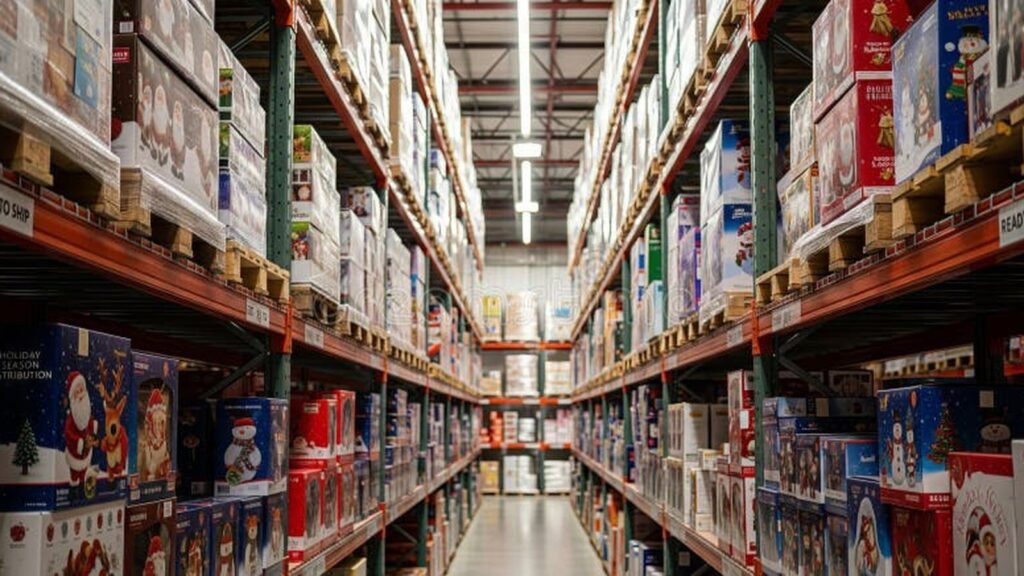

Selling seasonal products—Christmas decorations, summer beach gear, Halloween costumes, Valentine’s gifts—is a timing business. Order two months too late and you miss the season entirely, writing off an entire container of stock. The winning move is to work backwards from your sell-by date and build a calendar that accounts for Chinese factory capacity, shipping, and warehousing. This guide gives you the timeline.
1. The Core Principle: Back-Schedule From Your Sell Date
Start with the date your product must be on the shelf (or in the warehouse) and subtract each step. A typical full timeline for a sea-freighted product to the US/EU:
- On-sale date. The first day you can make money—e.g. November 1 for Christmas goods.
- Minus 2–3 weeks: receiving, inspection, FBA shipping, or warehouse shelving.
- Minus 35–45 days: ocean freight (China to US West Coast), plus 7–10 days for destination port clearance and drayage.
- Minus 25–35 days: bulk production, including pre-shipment inspection.
- Minus 10–15 days: sample approval, artwork, and mold/pigment preparation.
- Minus 7–14 days: final supplier selection and PO.
Add it up and Christmas goods sold on November 1 should be ordered in early May—roughly 5–6 months before the season. This is why experienced importers place Q4 orders in May and June.
2. Example Calendars for the Major Seasons
- Christmas / Q4 (on-sale Nov 1–Dec 15). Select suppliers in April, approve samples by May, place bulk PO in May–June, ship in July–August, receive in September. Avoid September shipping—you will miss the season.
- Summer / beach (on-sale May 1). Order in November–December; ship in February–March. This window collides with Chinese New Year, so plan around it.
- Halloween (on-sale Oct 1). Order in March–April; ship in June–July.
- Valentine’s Day (on-sale Feb 1). Order in August–September; ship in November. Again, CNY can delay a reorder.
3. Chinese New Year and Summer Capacity Shocks
Two calendar events distort every timeline:
- Chinese New Year (late January–February). Most factories shut for 7–14 days; production effectively stops 1–2 weeks before and restarts 1–2 weeks after. Plan to finish bulk production before the shutdown, or accept a 3–4 week delay.
- July–August summer lull and pre-Canton Fair rush. Factories are often swamped in September–October ahead of the October Canton Fair and Q4 shipping; lead times stretch by 30–50%.
4. Trial Order, Bulk Order, and Reorder Rhythm
For a new seasonal product, run a small trial first:
- Trial order (100–500 pcs). Arrive 2–3 months before the season; test your listing, conversion, and returns.
- Bulk order (full container). Placed only after the trial sells through. This is the safe approach for first-time seasonal items.
- Reorder by air. If a product outperforms, a second 100–300 kg shipment by air freight (7–10 days) can top up stock during the season at a higher unit freight cost—far better than missing sales.
5. What to Do If You Miss the Window
If you realize in September that your Christmas order will not land until December, options are:
- Switch a portion of the order to air freight or express to at least have some stock on time.
- Shift to clearance strategies: deep discounts, bundle deals, or donate stock for a tax write-off rather than holding it for a full year.
- Negotiate with the factory to split production—ship half now by air, half later by sea for next year.
Discipline—not luck—is what separates seasonal sellers who make money from those who liquidate pallets every January.
6. Forecasting Stock Levels for Reorders
Once you have historical sales data, set stock rules rather than guessing:
- Entry stock. Bring in enough for 60–75% of expected season demand, not 100%. This limits markdown risk.
- Reorder trigger. When sell-through hits 50% by mid-season, place an air-freight reorder of 20–30% of entry quantity.
- End-of-season stop. Stop all reorders 6 weeks before the sell-by date; any later order will not arrive in time.
- Liquidation plan. Pre-arrange a discount timeline (30% off, 50% off, donate) so you are not stuck holding stock into the next year.
Track sell-through weekly, not monthly. A seasonal product that is flat by early November will not suddenly sell in December.
7. Choosing What to Sell Each Season
The calendar only works if you pick the right products. Use last year’s sell-through data to double down on winners, and test only 1–2 new SKUs per season—not ten. Seasonal items have a narrow window; a product that fails to sell by the second week of the season rarely recovers. Keep entry inventory conservative and use air-freight reorders to feed winners rather than over-ordering speculative items. Factor in your own handling time as well—photos, listing copy, and PPC setup all take days, so build that buffer into the back-schedule.